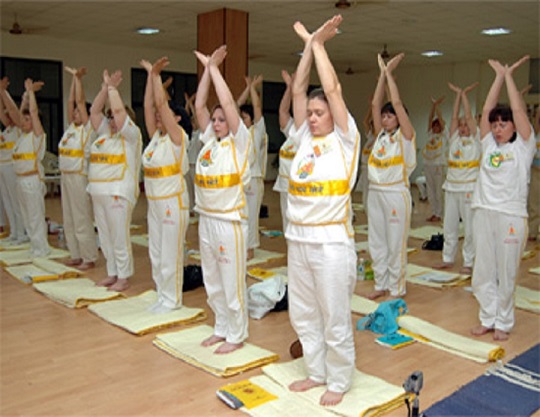
Since perception is the key to this meditation technique, it is known as Preksha Meditation. Here Preksha means to perceive and Dhyan means meditation. The word Preksha is derived from the root iksha, which means to see. When the prefix Pra is added, it becomes Pra+iksha, which now means to perceive carefully and profoundly being free from attachment and aversion.
In this technique, one has to observe the internal phenomenon of thebody . In the beginning a person observes the states of the gross body, then the phases of the taijas sharir, (the electrical body), followed by the vibrations in thekarma sharir (the micro body). At a more advanced stage of the meditation process, the practitioner may succeed even in witnessing his past life. Thus while progressing through the gross to the subtle bodies, the art of visualizing ones own self may be acquired. Acharya Siddhasena (6th Cent., A.D.) wrote, 'Let us observe the state of our body, perceive the form of our mind. Let us sit in meditation and observe the different states of our body.' Thousand of different kinds of changes occur in our body and to witness all these changes with inner eye is called the perception of self through self.
Sampikkhae Appagamappaenam this aphorism from the Jain canon Dasaveaaliyam forms the basic principle forPreksha Meditation . It means, 'See yourself through yourself.' Perceive and realize the most subtle aspects ofconsciousness through your own conscious mind.'
Acharya Siddhasena (6th Cent., A.D.) wrote, 'Let us observe the state of our body, perceive the form of our mind. Let us sit in meditation and observe the different states of our body.' Thousand of different kinds of changes occur in our body and to witness all these changes with inner eye is called the perception of self through self.
In order to achieve perfection in the technique of Preksha Meditation, one has to pass through various stages. The basic components of Preksha Meditation are: